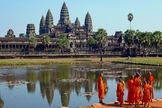
Welcome to Siem Reap, Cambodia
Siem Reap province is located in northwest Cambodia. It is the major tourist hub in Cambodia, as it is the closest city to the world famous temples of Angkor (the Angkor temple complex is north of the city). The provincial capital is also called Siem Reap and is located in the South of the province on the shores of the Tonle Sap Lake, the greatest sweet water reserve in whole Southeast Asia. The name of the city literally means Siamese defeated, referring to the victory of the Khmer Empire over the army of the Thai kingdom in the 17th century.
At the turn of the millennium Siem Reap was a Cambodian provincial town with few facilities, minor surfaced roads and little in the way of nightlife. Tourism industry catered largely to hardy backpackers willing to brave the tortuous road from the Thai border on the tailgate of a local pick-up truck. There were a couple of large hotels and a handful of budget guesthouses. Tuk-tuks and taxis were non-existent and the trusty motodup was the chosen means of touring the temples of Angkor.
The proximity of the Angkorian ruins turned Siem Reap into a boomtown in less than half a decade. Huge, expensive hotels have sprung up everywhere and budget hotels have mushroomed. Property values have soared to European levels and tourism has become a vast, lucrative industry. The Siem Reap of today is barely recognizable from the Siem Reap of the year 2000.
Though some of the town's previous ramshackle charm may have been lost the developments of the last few years have brought livelihoods, if not significant wealth, to a good number of its citizens. This has been at a cost to the underprivileged people living within and beyond the town's limits that now pay inflated prices at the central markets and continue to survive on poorly paid subsistence farming and fishing. If Cambodia is a country of contrasts Siem Reap is the embodiment of those contrasts. Despite the massive shift in its economic fortunes, Siem Reap remains a safe, friendly and pleasant town. There is an endless choice of places to stay or dine and a host of possible activities awaiting the visitor.
Siem Reap province is 10,299 square kilometres big and definitely one of the most famous ones in Cambodia. It's located in the Northwest of the country bordering to the North with Oddor Meanchey, to the East with Preah Vihear and Kampong Thom, to the West with Banteay Meanchey and to the South with the biggest sweet water reserve in Southeast Asia, the huge Tonle Sap Lake.
The province in general, especially in the Southern part consists of the typical plain wet area for Cambodia, covering lots of rice fields and other agricultural plantations. The northern part is turning into an undulating area covered with some deeper, green forests. A quite distinguished mark of Siem Reap Province is the smaller, but important Siem Reap River. It rises from Phnom Kulen, meanders through the northern part of Siem Reap Province and eventually into the Tonle Sap Lake.
WHEN TO GO?
Travelers can travel to Siem Reap all the time, thank to it warm temperature year round.
HOW TO GET THERE?
The majority of visitors to Siem Reap arrive by air from Phnom Penh and Bangkok. There are also regular flights from Singapore, Ho Chi Minh City and Vientiane. See the airline list below. Visas are available on arrival at the Siem Reap and Phnom Penh airports. From Phnom Penh, there are also daily boats and buses going to Siem Reap. Some visitors make their way to Siem Reap overland from Thailand via the Aranyaprathet/Poipet border crossing.
Siem Reap Airport:
Airport Departure and Arrival Tax: Domestic: US$6. International: US$25 Siem Reap Airport: The airport sits 6km from town, close to the temples, occasionally affording spectacular views of Angkor Wat during landings and take offs. Outside the terminal is a ticket booth for registered taxis into town. Independent taxis and motorcycles wait just outside the airport. The price is the same for both: motorcycles are $2 and cars are $6-7 into town. Most hotels offer free transportation from the airport but you must notify them in advance of your arrival.
Siem Reap Ferry Dock: The ferry to Siem Reap arrives at Chong Khneas near Phnom Krom, 12km south of Siem Reap. There is always transportation waiting at the dock. Mototaxis charge about $2-$3 and cars $6-$7 for the 20-30 minute ride into town.
River Ferry: Daily ferries ply the Tonle Sap river and lake between Phnom Penh and Siem Reap. The end of the trip is marked by a hill, Phnom Krom, near the ferry dock at Chong Khneas 12 km south of Siem Reap. During the dry season, the ferry stops short of the dock and passengers transfer to smaller boats to traverse the final few hundred meters.
Ferries depart 07:00am daily from the Phnom Penh Port on Sisowath Quay. Ferries depart Siem Reap daily at 07:00am from the dock at Chong Khneas. Passage is around $18-$25 and should be purchased a day in advance (251km, 4-6 hours). Drinks are sometimes available. Tickets can be purchased through hotels and travel agencies cheaper than at the ferry offices. Though generally safe, these ferries are local transport and have experienced breakdowns, groundings and other difficulties. Travel is best during the wet season (June-November). Dry season low waters can mean smaller, less comfortable boats and occasional groundings.
Buses: Several guesthouses, travel agencies and bus companies offer daily bus transport between Phnom Penh and Siem Reap. It is a smooth 314 km, 5-7 hour trip. The bus makes usually two stops along the way (at Skun and Kampong Thom). All charge the same, $3.50 (14,000R) one-way. The earliest buses depart starting at 06:30am and the last buses between noon and 01:00pm.
Neak Krorhorm Travel: Phnom Penh office at the corner of Street 110 and Sisowath Quay. Siem Reap office opposite the Old Market.GST: Phnom Penh bus station near the southwest corner of Phsar Thmey (Central Market). Phnom Penh Public Transport Co.: Phnom Penh bus station near the southwest corner of Phsar Thmey (Central Market).
Share Taxis: Local share taxi depart from southwest corner of Central Market in Phnom Penh for 25,000 riel per person (5-8 hours). A private taxi costs you US$38-$45 for the whole car. 5-6 hours. (Due to rising fuel costs, prices are in flux.)
Motorbike Information to Siem Reap: The road to Siem Reap is in good condition, but driving in Cambodia is still challenging in the extreme, and should be attempted only by experienced riders. Speeding taxis, slow cows, and oblivious children are the norm. The trip calls for a dirt or road bike, no smaller than 250cc. It can be made in a day, but two days with a layover in Kampong Thom is a more relaxed alternative and allows time to visit the pre-Angkorian ruins of Sambor Prei Kuk.
Leave Phnom Penh via the Japanese Bridge and follow National Highway No 6 north 75km to the Skun intersection. (Skun is known for its exotic foods - check out the fried spiders, turtle eggs and more at the roadside stands.) Bear left and follow the NH No 6 to Kampong Thom - about 2-3 hours. In Kampong Thom, the Arunras Hotel (062-961294), Stung Sen Royal Hotel (012-309495) and Mittapheap Hotel are all decent mid-range places. Arunras Guesthouses and Restaurant next to the hotel is the place to eat cheaply. From Kampong Thom to Siem Reap the trip takes another 2-3 hours.
WHERE TO STAY?
As Angkor Wat I temple complex become popular to tourists, there are a lot of hotels of all budgets built over the last years. Please contact us at anytime for FREE information.
WHAT TO DO?
Angkor Wat Temple
There are few places anywhere on earth to match the splendour of Angkor Wat. The temple is one of the largest monuments to religion ever built and is truly one the wonders of the world. Believed to have been constructed as a temple and mausoleum for King Suryavarman II at the peak of the Khmer empire in the first half of the 12th century, Angkor Wat is probably the best-preserved of the Angkorean temples. As with other Angkorean temples and walled cities such as Angkor Thom, the central theme of Khmer architecture revolved around the idea of the temple-mountain.
By the time building on Angkor Wat was begun early in the 12th century, this had been elaborated to a central tower surrounded by four smaller towers. The central monument represents the mythical Mount Meru, the holy mountain at the centre of the universe, which was home to the Hindu god Vishnu. The five towers symbolise Mount Meru's five peaks. It is difficult to express in words the enormous scale of Angkor Wat, but it can be explained in part by a look at the dimensions of the complex. The temple is surrounded by a moat which makes the one around the Tower of London, built at roughly the same time, look like nothing more than a garden trench.
At 190 metres wide and forming a rectangle measuring 1.5 km by 1.3 km, it is hard to imagine any attacking force overwhelming the defences. But the moat was more than just a defensive bulwark, in line with the temple's Hindu origins it represented the oceans of the world. A rectangular wall measuring 1025 metres by 800 metres borders the inner edge of the moat. There is a gate in each side of the wall, but unusually for the mainly Hindu-influenced Angkorian temples, the main entrance faces west. This entrance is a richly decorated portico, 235 m wide with three gates. However, the temple's greatest sculptural treasure is its 2 km-long bas-reliefs around the walls of the outer gallery and the hundred figures of devatas and apsaras. This intricately carved gallery tells stories of the god Vishnu and of Suryavarman II's successes on the battlefield. The whole complex covers 81 hectares.
Banteay Kdei Temple
The citadel of the cells . In the ruin and confusion of Banteay Kdei the carvings take one's interest. They are piquant, exquisite, not too frequent... they seem meant.. to make adorable a human habitation.
Banteay Kdei is located south of Ta Prohm temple. A enter the monument from the west and leave at the west or vice versa, either way, also visit Srah Srang. It was built in middle of the 12th century to the beginning of the 13th century by king Jayavarman II in Mahaya Buddhism with following at least two different art periods Angkor Wat and Bayon -are discernible at Banteay Kdei.
BACKGROUND:
Banteay Kdei has not been restored and allows the visitor to experience what it may have looked like originally. Changes and additions account for is unbalanced layout. Banteay Kdei was built of soft sandstone and many of the galleries and porches have collapsed. The wall enclosing the temple was built of reused stones.
LAYOUT
The temple is built on the ground level use as a Buddhist monastery. The elements of the original design of Banteay Kdei seem to have been a Central Sanctuary (5), a surrounding gallery (6) and a passageway connected to another gallery. A moat enclosed the original features of the temple. Another enclosure and two libraries were among the additions in the Bayon period. The outer enclosure (700 by 500 meters 2,297 by 1,640feet) is made of laterite (1) and has four entry towers.
A rectangular courtyard to the east is known as 'the hall of the dancing girls', a name derived from the decoration which includes dancers (2) The entry tower of the second enclosure (3) is in the shape of a cross with three passages; the two on either end are connected to the literate wall of the enclosure (4) 320 by 200 scrolls of figures and large female divinities in niches. In the interior court there is a frieze of Buddha.
A causeway of a later date, bordered with serpents, leads to the entry tower of the third enclosure. It comprises a laetrile wall (6) includes a gallery with a double row of sandstone pillars that open onto a courtyard. Tip Parts of this area have been walled in and passage is limited. Vestiges of the wooden ceiling can still be seen in the central Sanctuary. The galleries and halls, which join it in a cross to the four entry towers, are probably additions. Two libraries (7) open to the west in the courtyards on the left and right of the causeway.
Tonle Sap Lake
Five provinces circled the area of Tonle Sap Lake, more than three million of population inhabited around the bank of the Lake and 90% of them earn a living by catching fish and making agricultures. As you can see on the map of Cambodia It stretches across the northwest section of the country.
Tonle Sap Lake is the largest fresh water in South East Asia. Its dimension changes depending on the monsoon and dry season. During raining season from June to October, Tonle Sap Lake is filled by water flowing from the Mekong with 14 meters in depth and expands the surface of 10,000 square Kilometers. In dry season from November to May its size 3,000 square kilometers with two meters in depth and water flows out from the Lake to the Mekong, in and out flowing is the natural phenomenon occurrences. The flooded forest surrounding the edge of Tonle Sap Lake is the best shelter and also very important for all kinds of fishes spawned and breeding babies. Tonle Sap Lake providing many of biodiversities, over 300 species of fresh water fishes, as well as snakes, crocodiles, tortoises, turtles and otters. More than 100 varieties water birds including storks, pelicans, etc
Tonle Sap Lake is also an important commercial resource, providing more than half of the fish consumed in Cambodia. In harmony with the specialized ecosystems, the human occupations at the edges of the lake is similarly distinctive - floating villages, towering stilted houses, huge fish traps, and an economy and way of life deeply intertwined with the lake, the fish, the wildlife and the cycles of rising and falling waters.
Tonle Sap Lake located about 15 km south of Siem Reap town. So you can do your journey from Siem Reap to Phnom Penh by express boat crossing the lake and dock at the village of Chong Khneas. Its takes only six hours, but this trip we may recommend you during Monsoon season. In dry season, the boat sometimes stuck in mud because the water is low. There are several ways to see the culture and wildlife of the lake area depending on the amount of time you have and your interest.
Chong Khneas is the name of famous floating village at the edge of the lake. It locates at Southern part of Siem Reap town about 15 Km, and takes only 30 minutes by vehicles to the boat dock where there are always boats waiting for visitors. The boat trip through the floating village takes approximately two hours. You will explore the different of Khmer, Muslim and Vietnamese floating households and the floating markets, fisheries, clinics, schools, basketball course, pigsty and other boatloads of tourists.
Chong Khneas, was before very interesting, but now region is owned by private firm they did increasing prices and the area looks more commercial. The boat trip usually includes two stops: one at a touristy floating 'fish and bird exhibition' with a souvenir and snack shop, and the other at the very highly recommended Gecko Environment Centre, which offers displays and information introducing the ecology and biodiversity of Tonle Sap lake area.
Phnom Bakheng Temple
Phnom Bakheng is a temple built on a hill of the same name, where the first city at Angkor was established. This gives its state temple on Phnom Bakheng special significance. It was to here that Yasovarman I moved his capital from Roluos. His capital city, called Yasodharapura, was larger than Angkor Thom, which came later, and was centred around the hill of Phnom Bakheng.
The design of the temple of Bakheng borrowed elements from the Bakong which was built 20 years earlier. Both are step pyramids of ascending square terraces. We do know that work on the temple began at the end of the 9th century. The lingga in the central sanctuary was dedicated around 907AD, while construction work continued. The temple was called Yasodharesvara, after its patron deity, which means Lord who Bears Glory. In 928 the temple was abandoned, only to be briefly rehabilitated in 968 by Jayavarman V.
Preah Khan temple
Preah Khan temple is located 2 kilometers north-east of Angkor Thorn on the Grand Circuit. The temple was built in the second half of the 12th century in AD 1191 by King Jaya-varman VII, dedicating to his father Dharanindravarman. The Buddhist complex covers 56 hectares served as the nucleus of a group that includes Neak Pean and Ta Som, located 4 kilometers long Jayatataka Baray—the last of the great reservoirs to be built in Angkor.
The inscription indicates that Preah Khan was built on the battle site where King Jaya-varman VII finally defeated the Chams. In those days it was known as Nagarajayacri which mean the city of Preah Khan.
Four concentric ramparts subdivide Preah Khan. The outer or fourth wall, which is encircled by a wide moat, today en¬closes a large tract of jungle, formerly the living quarters of the monks, students and attendants of Preah Khan. The second rampart delineated the principle religious compound of about four hectares within which there is a dense concen¬tration of temple and shrines. The central complex is Bud¬dhist. The northern and western sectors are dedicated toBrahmanism— Vishnu (west) and Shiva (north), whilst the southern sector is a place of ancestor worship. The eastern sector forms the grand entrance to the central shrine.
A place for a king located near Preah Khan temple is called Veal Reacheak or Preah Reachea Dak. It is 1,500 meters long and 1,200 meters wide. Nearby about 700 meters north of Preah Khan temple along the road to Angkor Thorn district is another small temple called Ptu. The temple was made of laterite.
Baphuon Temple
This temple built by Udayadityarvarman II was the most poorly constructed of all the temples in Angkor. From the remaining ruins, it is possible to see how imposing it was. This temple hill was dedicated to Shiva, but in its reliefs many motives from the Vishnu epic can be seen. Restoration work continues to be carried out on the Baphuon.
North o f the Golden Tower [Bayon]. rises the Tower of Branze [Baphuon] higher even than the Golden Tower : a truly astonishing spectacle , with more than ten chambers at its base. Prasat Baphuon is located 200 metres (656 feet) northwest of the Bayon and south of Phimeanakas. A enter and leave at the east.
Tip: Access to the summit is difficult as much of the temple has collapsed and it is overgrown but for those stalwarts who want to go to the top, use the way with columns at the east and the temple of Phimeanakas on the left. Visitors should walk down the causeway, climb the steps to the first tier, turn left and walk around the temple, always keeping it on their right. It was built in middle of the 11th century (1060) by king Udayadityavarman II, dedicated to Siva (Hindu) with following Prasat Baphuon.
BACKGROUND:
The grandeur of Baphuon as described above by Zhou Daguan is unrecognizable today because of the poor condition of the temple. The French were in the process of restoring this temple when they were forced leave Angkor in 1972 because of war. Baphuon is situated inside the royal city of Angkor Thom but dates from the eleventh century and was built before the city was established. An interesting feature of Baphuon are the bas-reliefs which are scenes carved in small squares.Unfortunately few of these are visible because of the poor state of the temple. The narrative themes are realistic depictions of daily life and forest scenes.
LAYOUT:
Baphuon is a single sanctuary temple-mountain situated on a high base. It is a symbolical representation of Mount Meru. A rectangular sandstone wall measuring 425 by 125 metres (1394 by 410 feet) encloses the temple (1). A long sandstone elevated approach (200 metres, 656 feet) at the east entrance (3) forms a bridge to the main temple. It is supported by three rows of short columns.
Tip: Before walking down the approach turn left at the east entry tower (2) and walk to the end of the gallery for a superb view of a four-faced tower of the Bayuon framed by a doorway of Baphuon. The approach is intercepted by a pavilion in the shape of a cross (4) with terraces on the left and right sides. Turn left and walk to the opening the approach. Continue to the view of the arrangement of the imposing pillars under the approach. Continue to the end of the gallery to see a rectangular paved pool (5).
The temple stands on a rectangular sandstone base with five levels that are approximately the same size, rather than the more common form of successively smaller levels. The first, second and third levels are surrounded by sandstone galleries. Baphuon is the first structure in which stone galleries with a central tower appear. Two libraries (6) in the shape of a cross with four porches stand in the courtyard. They were originally connected by an elevated walkway supported by columns.
The gallery of the enclosure collapsed and, at a later date , the stones from it were modeled into the shape of a reclining Buddha (7) that spans the length of the west wall ( the head is on the left, facing the temple) . It is an abstract form and the outline of this Buddha is difficult to distinguish. A stairway (8) leading to the summit begins in the middle of the Buddha. The top level is in poor condition due to several collapses. Originally there was a Central Sanctuary with two wings. Each side of the entrance to the Central Sanctuary is carved with fine animated figures. If you look carefully you can see these from the ground on the west side.
Tip: The view from the top with Phnom Bakheng in the south and Phimeanakas in the north is magnificent.
Banteay Samre Temple
Banteay Sam Re located at Preah Dak commune, Bon Tiey Srey District by Charles De Gaulle Road via Angkor Wat in 16-kilometer distance from the provincial town of Siem Reap.
This temple is somewhat islocated, and you should be vigiland of your possessions and travel with a local guide. The temple is worth the extra effort to experience the elaborate architecture, and fine carvings, although theft has mutilated many of the temple's treasures.
Location: 400 meters (1,312 miles) east of the East Baray
Access: enter and leave Banteay Samre from the east.
Date: middle of the 12th century
King: Suryavarman II (reigned 1113-1150)
Religion: Hindu (dedicated to vishnu)
Art Style: Angkor Wat
BACKGROUND
Banteay Samre is one of the most complete complexes at Angkor due to restoration using the method of anastylosis. Unfortunately, the absence of maintenance over the past 20 years is evident. The name Samre refers to an ethnic group of mountain people, who inhabited the regions at the base of Phnom Kulen and were probably related to the Khmers. No inscription has been found for this temple, but the style of most of the architecture is of the classic art of the middle period similar to Angkor Wat. The monument most likely dates from the same period, or, perhaps, slightly later, although there are additions attributed to the Bayon style. The proportions of Banteay Samre are plended. A unique feature is an interior moat with laterite paving, which when filled with water must have given an ethereal atmosphere to the temple. All of the buildings around the moat are on a raised base with horizontal mouldings, decoreated in some areas with figures framed by lotus buds.
Banteay Srey Temple
Location: 25 kilometers (15.5 miles) north-east of East Mebon
Access: enter and leave the temple by the east entrance
Date: second half of the 10th century (967)
King: Rajendravarman II (reigned 944-968) and Jayavarman V (reigned 968-1001)
Religion: Hindu (dedicated to Shiva)
Art style: Banteay Srei
The tenth century temple of Banteay Srei is renowned for its intricate decoration carved in pinkish sandstone that covers the walls like tapestry. This site warrants as much time as your schedule allows. The roads have been recently repaired and it takes about 30 minutes from Siem Reap to get to the temple.
To reach Banteay Srei, follow the main road north out of Siem Reap, turn right at Angkor Wat and follow the road to Srah Srang where you turn right past Preah Rup. At the East Mebon there is a check post where you need to obtain clearnce. Turn right again at the road before the East Mebon; pass through the village of Phoum Pradak, where there is a junctions (if you continue straight, after about 5 minutes, you will reach Banteay Samre). At this point, you come to a fork; take the road on the left and follow it to Batneay Srei which you will reach shortly after crossing two rivers - on your left hand side.
Banteay Srei is an exquisite miniature; a fairy palace in the heart of an immense and mysterious forest; the very thing that Grimm delighted to imagine, and that every child's heart has yearned after, but which mature years has sadly proved too lovely to be true. And here it is, in the Cambodian forest at Banteay Srei, carved not out of the stuff that dreams are made of, but of solid sandstone.
The enchanting temple of Banteay Srei is nearly everyone's favorite site. The special charm of this temple lies in its remarkable state of preservation, small size and excellence of decoration.
The unanimous opinion amongst French archaeologists who worked at Angkor is that Banteay Srei is a 'precious gem' and a 'jewel in Khmer art'. Banteay Srei, as it is known by locals, was originally called Isvarapura, according to inscriptions. It was by a Brahmin of royal descent who was spiritual teacher to Jayavarman V. Some describe it a s being closer in architecture and decoration to Indian models than any other temple at Angkor. A special feature of the exquisite decoration was the use of a hard pink sandstone (quartz arenite) where enabled the 'technique of sandalwood carving with even an Indian scent to it'.
Khmer Classical Dancing
No visit to Cambodia is complete without at least a quick glimpse of women performing the ancient art of apsara dance, as depicted on the walls of Angkor’s temples. Wearing glittering silk tunics, sequinned tops (into which they are sewn before each performance to achieve the requisite tight fit) and elaborate golden headdresses, performers execute their movements with deftness and deliberation, knees bent in plié, heels touching the floor first at each step, coy smiles on their faces. Every position has its own particular symbolism – a finger pointing to the sky, for instance, indicates “today”, while standing sideways to the audience with the sole of the foot facing upwards represents flying.
In the reign of Jayavarman VII there were more than three thousand apsara dancers at court – although dances were performed exclusively for the king, and so prized was their skill that when the Thais sacked Angkor in the fifteenth century, they took a troupe of dancers back home with them. Historically, the art form was taught only at the royal court, but so few exponents survived the ravages of the Khmer Rouge that the genre was very nearly extinguished. Subsequently, when Princess Boppha Devi – who had been a principal dancer with the royal troupe – wished to revive it, she found it helpful to study temple panels to establish the movements. It was not until 1995, a full sixteen years after the fall of the Khmer Rouge, that Cambodians once again witnessed a public performance of apsara dance, at Angkor Wat.
These days, the Royal University of Fine Arts in Phnom Penh takes much of the responsibility for training dancers, who are chosen not only for aptitude and youth (they start as young as 7), but for the flexibility and elegance of their hands. It takes six years for students to learn the 1500 intricate positions, and a further three to six years for them to attain the required level of artistic maturity. Also taught is the other principal Cambodian dance genre, tontay, in which the emphasis is on depicting folk tales and episodes from the Reamker. You’ll be able to watch both styles of Cambodian dance in the cultural performances put on by hotels and restaurants in Siem Reap and Phnom Penh.
WHERE TO SHOP?
Siem Reap is an excellent place to buy Cambodian souvenirs, handicrafts, textiles and art. Only Phnom Penh offers a comparable selection, but much of what is available in Siem Reap is unique to Siem Reap. Until recently, the Old Market (Phsar Chas) and vendors at the temples were the only places to buy souvenirs. Over the last few of years there has been a small boom of new shops, galleries and boutiques, offering a more varied selection of quality handicrafts and silks as well as original artistic creations - paintings, prints, carvings and such.
The Old Market still has the widest variety of souvenirs, as well as the best selection of items such as baskets, silver work and musical instruments. It also offers an interesting local ambiance, but the boutiques, galleries and specialty shops offer generally higher quality items and a more sophisticated selection of Cambodian products. Of particular interest are the traditional craft workshops and silk farms where you can see crafts in the making as well as buy the final product.
When purchasing local crafts, be selective in your purchase as there might also be some fakes. Most of the crafts, particularly the carvings, silk products and silverwork are hand-made, making each piece a unique work. Masters as well as students produce much of what is available, so some pieces are significantly better than others.
WHERE TO EAT?
There is no shortage of restaurants in Siem Reap. They have been opening steadily over the past couple of years. Siem Reap offers an excellent variety of restaurants. Shinta Mani and Hotel Grand D'Angkor lead the fine dining category though there are several places offering excellent cuisine in a stylish, refined atmosphere. There are also plenty of moderately priced Cambodian and international restaurants. Almost every restaurant offers Cambodian food. For the budget minded, check out the inexpensive Chinese places at the south end of Sivatha Blvd. or the local food stalls and noodle cookshops next to Phsar Char (Old Market).
Dinner Theater: Attending a traditional dance performance is a must when visiting Cambodia. Several restaurants offer dinner performances. Nightly performances: Grand Hotel D?Angkor, Apsara Theater, Kulen II, Angkor Mondial, Chao Pra Ya, Tonle Mekong, and Tonle Sap. Some restaurants, such as the Dead Fish Tower, offer traditional music during the dinner hour. Shadow puppetry can be seen at Bayon 1 and La Noria Hotel.
Pubs, Bars & Life night: A traditional dance performance at one of the dinner theatres is a perfect place to begin the evening. If you're looking for something a bit more conventional, there are a variety of places from which to choose. The piano bar at Grand D'Angkor, and the live traditional music at Dead Fish Tower make for pleasant venues to begin the evening. Buddha Lounge, Ivy Bar, The Red Piano, Temple Bar, Linga Bar, Molly Malone's, Angkor What and not to forget the bars of the Pub Street where you can find popular early evening pubs, drawing tourists and expats alike, and getting more crowded as the evening progresses. Pub Street in the Old Market area is the happening place to be in the evening these days offering several bars and restaurants, not only on Pub Street, but on nearby streets and allies. Things get going in the late afternoon and some places stay open quite late.
source: tourismcambodia.com
Featured tours
Incredible cruise in Halong Bay, Unesco World Heritage Site since 1994
Amazing cruise experiences in Halong Bay, Vietnam
Incredible cruise in Halong Bay, Unesco World Heritage Site since 1994
Incredible cruise in Halong Bay, Unesco World Heritage Site since 1994
Discover the most interesting places of Indochina with World Heritages Sites such as Halong Bay, Phong Nha - Ke Bang grottoes, Hue...